


Did you know we have a podcast featuring solid biblical teaching? It’s called In the Word with Malcolm Webber, and we release it weekly, along with doctrinal teaching that goes beyond information into transformation. Check it out!
Hello friends,
We are continuing our series on listening — what it is, why we need to get better at it, the levels of listening, and the ways we can improve both our own listening and the listening of others around us.1
Not many people are good at listening. In fact, considering how important listening is to our relationships with others, our personal growth, and our effectiveness in life and ministry, it can be downright embarrassing to realize how ineffective we are at it!
Perhaps you’re coming from the listening effectiveness inventory we included in our last issue a little discouraged with your results. Or maybe you just had one of those conversations with a coworker where you just seemed to be talking past each other.
The good news is that like any skill worth having, we can get better at listening. And we’re devoting the last few issues of the year to doing just that.
The first thing we need to do is recognize the barriers we face whenever we enter into a conversation. Knowing these barriers will help us to overcome them, so let’s take a look at each in turn.
Barrier 1: Sin
Not listening properly is often just human failing. However, ever since the Fall, men and women have been self-centered, self-absorbed, self-interested, self-seeking, self-loving, selfish, self-willed, proud and rebellious. “Why do I have to listen to you?” is our common and defiant cry from the time we are able to talk.
We don’t listen well to others not only because we have never been taught to listen, but because we don’t want to listen.
Because of this, true listening must begin with heart change. It is not simply a skill that can be learned. Through daily union with Jesus Christ in His death and resurrection (Rom. 6), understanding the listening love of our Lord, we as Christian leaders can be effective listeners.
…count yourselves dead to sin but alive to God in Christ Jesus. (Rom. 6:11)
Listening is an act of self-sacrifice. It is an expression of our genuine love for others.
Each of you should look not only to your own interests, but also to the interests of others. (Phil. 2:4)
Often, our faulty understanding of what leadership is — and the expectations placed upon us — will exacerbate our sinful self-centeredness when it comes to listening. One of the pastors we serve in India pointed this out recently:
“As a church pastor, I thought that I had to know everything and know just what to do. I thought that my wife and congregation were supposed to fully obey what I said. This training has convicted me of my sins and my inner arrogance. I realized that I have to have the mind of Christ, be considerate, and listen to others.”
Barrier 2: The difficulty of the communication process itself
It is unrealistic to think that effective listening by itself will automatically ensure complete success in communication.
Take a look at this simple model of communication. The speaker shares a message with the listener who, in turn, gives feedback to the speaker regarding the content of his message.
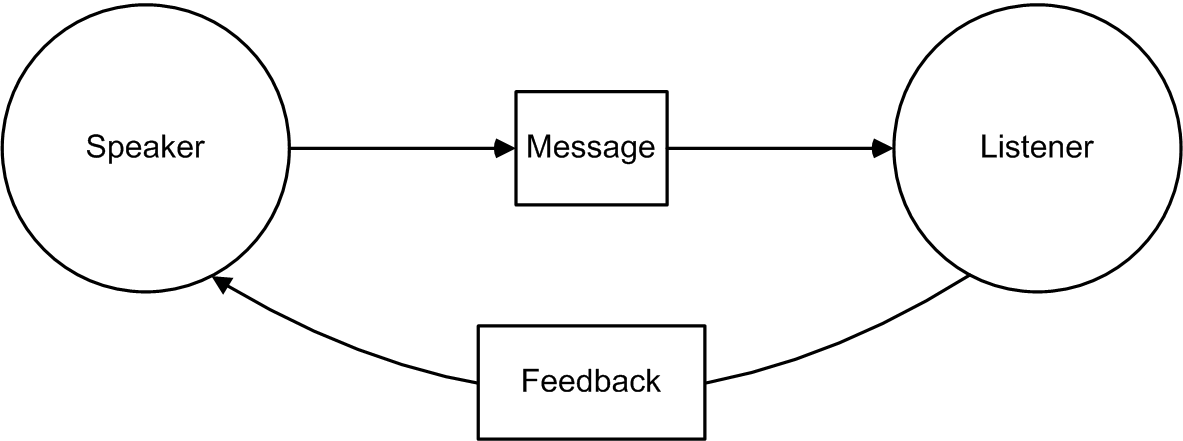
It would be nice if this was how it worked, right?
Unfortunately, communication is not this simple. Because words are such imprecise carriers of ideas, it is easy for the intended meaning of the speaker to be distorted or lost in the dialogue.
In reality, there are at least five significant challenges in the communication process:
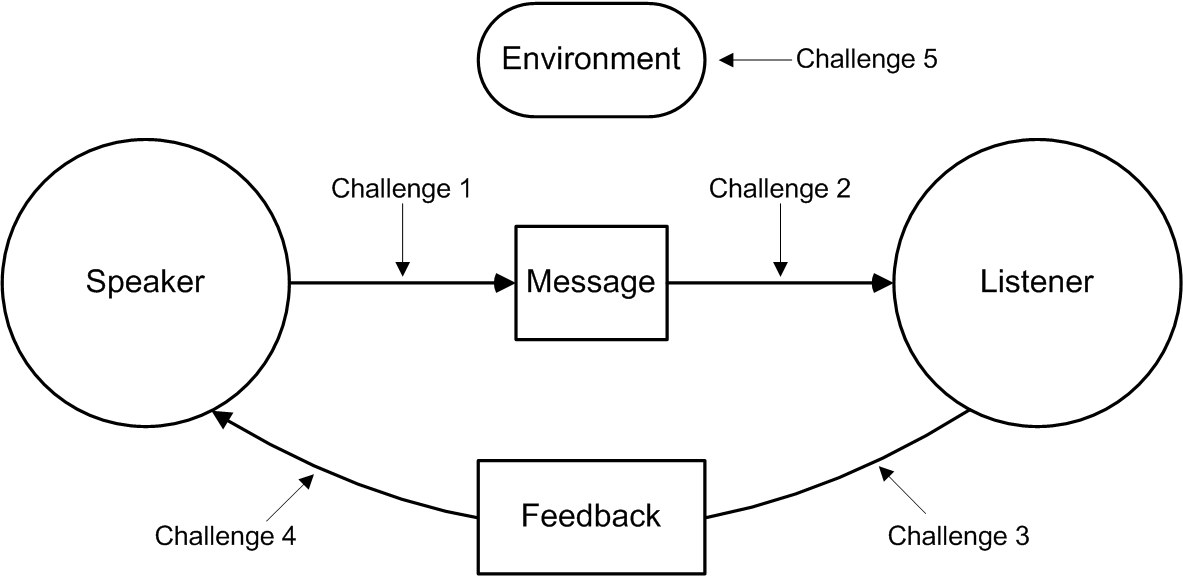
The first challenge consists in the speaker being able to choose the appropriate words2 necessary to accurately express his intended meaning. Of course, a certain word can mean one thing to one person and something quite different to someone else.
The listener may or may not properly understand the intended significance of the chosen words (challenge 2).
The listener then frames his feedback, choosing words that, again, may or may not accurately reflect his intended meaning, to the original speaker (challenge 3) who then has the challenge of correctly interpreting the feedback (challenge 4).
The fifth challenge in this process is the environment — both internal (e.g., worry, tiredness) and external (e.g., noise, other people) — which provides many additional distractions and opportunities for the meaning to be obscured or lost altogether.
In view of these challenges, it is no wonder that there is a wealth of research data showing that the general efficiency of the communication process is very low, often five percent — a figure approaching statistical randomness! Thus, Wiio’s3 first law of communication states, “Communication usually fails, except by chance.”
No matter how you slice it, effective communication is hard!
Barrier 3: Learned passivity
Many of us have learned to be passive listeners. Two of the most significant ways we have learned this are through education and entertainment.
At school, we are praised when we do well at reading, speaking and writing. Listening, though expected, is not often recognized or rewarded. Very few schools deliberately teach listening skills.
In addition, formal education often treats students like buckets to be filled up with the right information, leading to a one-way transfer of knowledge that only requires passive listening to intake. Communication however — and effective, active listening — must be a two-way process in which both parties are fully engaged.
This happens in every culture around the world, of course:
“In the past, when we taught the truth, we would cover a lot of content in one session. The teaching was mainly lecture-based, and the students passively received it with little interaction. As a result, the children were not very interested and did not retain much; they might forget what they learned by the next week.” (leader from East Asia)
After this leader’s church moved to designs that engaged all four dynamics — combining the content with a holistic context — even the younger Sunday School kids were able to accurately recall what the lesson was about. She later reported that children who “used to be silent during worship now open their mouths to praise God.” This went beyond just information transfer to deep, spiritual impact.
It is possible to teach active listening, but it takes a holistic context!
Just like at school, the communication process in many forms of entertainment is usually one-way. Many studies indicate that heavy screen use encourages passivity and stunts the growth of the imagination. At the very least, it discourages the habits of active listening, or the possibility of interaction with a human being who might challenge us to work harder on listening.
In short, from childhood, we have learned to be passive recipients: disengaged, inactive, “hearing” but not really listening. We’re facing an uphill battle.
Barrier 4: Filters
Filters are the various internal “lenses” we use as humans, through which we filter and interpret everything we see and hear. The following are some common human filters:
Beliefs
Values
Attitudes
Personality
Culture
Prejudices
Interests
Expectations
Assumptions
Memories
Images, past and future
Past experience
Although all of us possess these internal lenses, we are often blind to the fact that we are using them. We do not realize how much they “color” what we hear and how we respond. Without healthy self-reflection, we might find ourselves in the position of the fool:
A fool finds no pleasure in understanding but delights in airing his own opinions. (Prov. 18:2)
Being aware of these filtering lenses is a significant step toward becoming a better listener.
Barrier 5: Habits
There are many internal habits — learned or intrinsic — that prevent us from effective listening.
For example:
Jumping in before the other person is finished.
Letting our minds wandering to things that are more relevant or interesting to us.
Not being open to the subject matter if its value is not immediately apparent.
Becoming defensive when the subject is negative towards you.
Not valuing a conversation that you did not initiate.
Trying to do other things while you listen, or “multi-tasking.”
Thinking ahead to what you’re going to say next, instead of giving your full attention to the speaker.
Judging the speaker and not giving him a chance to change your mind.
Avoiding listening because the speaker’s voice, manner or physical appearance is unpleasant.
Yielding to emotions regarding the subject and therefore being unable to calmly consider what is being said.
Trying so hard to look interested and to otherwise please the speaker that you don’t hear his words.
Adding to or taking away from the speaker’s words in your mind, or only hearing what you want to hear.
These habits are not the end of our listening careers. We just need to recognize them and start combatting them with better habits.
Barrier 6: Misconceptions
One major barrier to effective listening is the myth that speaking represents power. In our society, the one who speaks is seen as the active and powerful one, while listening signifies weakness and compliance.
But effective listening is, in reality, active and influential. The good listener can actually direct the conversation by his sensitive and well-placed responses:
The purposes of a man’s heart are deep waters, but a man of understanding draws them out. (Prov. 20:5)
The effective listener will find himself well-positioned to:
Cheer up anxious hearts (Proverbs 12:25)
Sustain the weary (Isaiah 50:4)
Bring healing (Proverbs 12:18; 16:24)
Turn away wrath (Proverbs 15:1)
Build others up (Ephesians 4:29)
Powerful words can only be spoken after effective listening.
Barrier 7: External distractions
In addition to all the internal distractions mentioned above, there are also many significant external distractions that affect our ability to listen effectively.
For example:
Barriers such as desks or physical distance between speaker and listener.
Faulty acoustics which make it difficult to hear.
The accent of the speaker.
The time of day, such as lower energy times like after lunch or late at night.
Personal problems that weigh on us.
Distractions, such as noise, other people, activities, animals, traffic, machinery, views of outside scenery, etc.
Interruptions, such as phone calls.4
Time pressures, such as deadlines.
For effective listening to be possible, such distractions need to be minimized.
Barrier 8: The use of “trigger” words
Certain words or ideas carry lots of emotion. Using them has the tendency to shut down the communication process.
The words and phrases we choose to use (let alone our tone and voice quality) can express accusation, hurt, offense, insult, distrust, cynicism, sarcasm, scorn, judgmentalism, rejection, etc.. “Trigger” words can vary from person to person, from relationship to relationship, and from culture to culture.
We must be careful that we avoid such words or ideas ourselves when we speak. And we must also be careful not to react or resist when someone speaking to us uses such words.
This is where charity and grace come in. As Christians, we can overlook a fault for the sake of loving, active listening, because Jesus has done the same for us. When “trigger” words come up in conversation, we can aim to stay cool, and try to discern the underlying idea the speaker is trying to express.
Barrier 9: Insufficient attention to nonverbal communication
Much of our communication is delivered nonverbally. Even when an individual is not talking, he is still communicating in some manner.
There are three main ways that communication takes place:
Words
Vocal tone
Body language (facial expressions, posture, gestures, eye contact)
Nonverbal communication is extremely important, and we should be thinking about it as we go about improving our listening.
Think of the times people have influenced you simply by the way they looked at you. They didn’t even need to say a word!
Face color changes as people talk about things that affect them emotionally. Movements of the lips, mouth, cheek muscles and eyebrows reveal what is going on inside the speaker, not to mention the movements or posture of the rest of the body, including the hands and the feet. A great range of emotions and attitudes can be revealed through body language, as Proverbs points out:
A scoundrel and villain, who goes about with a corrupt mouth, who winks with his eye, signals with his feet and motions with his fingers, who plots evil with deceit in his heart – he always stirs up dissension. (Prov. 6:12-14)
In addition, the speaker’s tone can often convey more meaning than his words. The effective listener must pay attention to the pitch, rate, timbre and subtle variations in the tone of the speaker’s voice.
The reality is that a person cannot help but communicate. Though he may decide to stop talking, it is impossible for him to stop communicating. The reading of nonverbal communication, therefore, is one of the most significant skills of effective listening.
How Can We Apply This?
We might be tempted, at this point, to throw our hands up in frustration. If this is how hard active listening is — let alone communicating things clearly when we speak — how is it even possible to communicate well at all?
Every problem in communication, however, is also an opportunity. By understanding these barriers, identifying them, and neutralizing as many of them as possible when we come to a conversation, we can begin to grow in our listening.
Reflect on the barriers listed here, taking some time to evaluate where they might have been at play in recent conversations for you. How can you remove some of them for the next one? We’d love to hear your ideas in the comments!
Recommended Resources
Book: Listening
Video Course: Transformational Thinking
For more resources, visit our website.
Much of what we’ll discuss in this series is rooted in Malcolm’s book, SpiritBuilt Leadership 12 — Listening.
In addition, the many kinds of non-verbal communication, which will be discussed later, also compound the difficulty of this process for both parties.
Osmo Wiio is a communication researcher from Finland.
One of our leaders once said of a spiritual retreat he ran, “To get these pastors to merely put their phones down for a week is a miracle.”